

Kitchen Island Ideas for Open-Concept LA Homes
If you’ve been Googling kitchen island ideas for open-concept LA homes, I want you to know, you’ve landed in the right place, and I’m so glad you’re here.
I’m Karina Rizzo, founder of Karamia Designs, and I’ve been designing kitchens across Los Angeles for years. From light-filled open-concept homes in Santa Monica to grand entertaining spaces in Beverly Hills, I’ve seen firsthand how one well-designed kitchen island can completely transform the way a family lives. Not just how their home looks, but how they actually use it, every single day.
That’s what we’re going to talk about today. Not just what looks beautiful (though we’ll absolutely get to that), but what actually works for real life in Southern California, the entertaining, the busy mornings, the kids doing homework, the dinner parties that spill from the kitchen into the living room and out to the patio.
Whether you’re deep into a kitchen remodeling Los Angeles project or just starting to dream, this guide is for you. Let’s get into it.
Why Kitchen Islands Are Essential in Open-Concept Homes
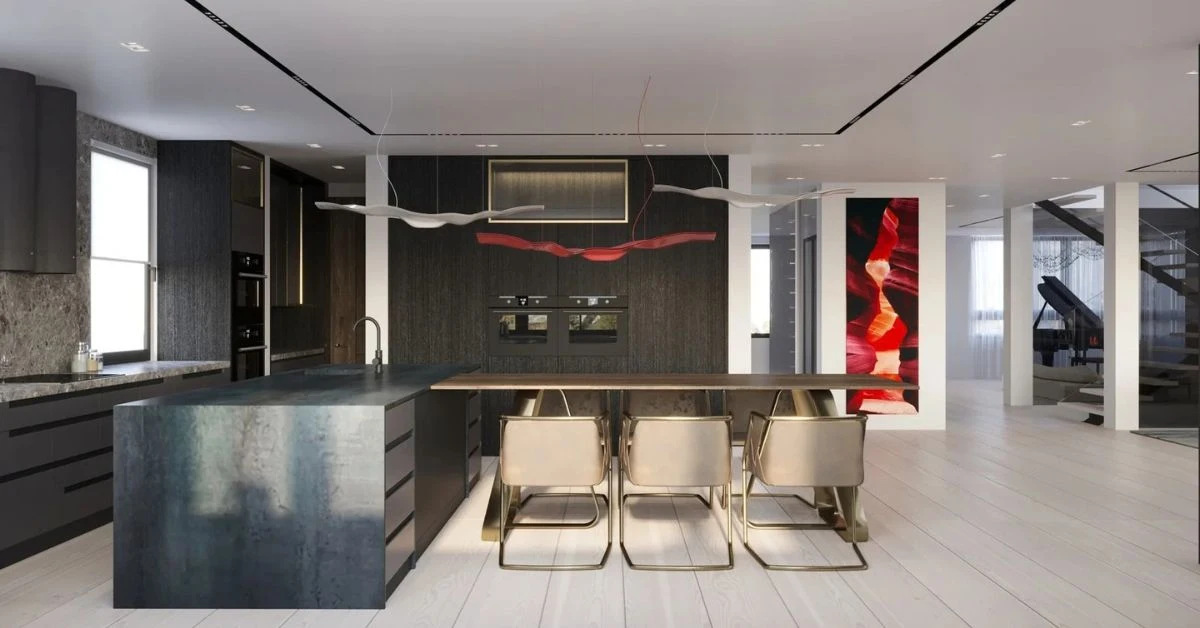
Here’s something I tell every client who walks through my door: the kitchen island isn’t a feature. It’s the foundation of your entire open-concept floor plan.
When you remove the walls between your kitchen, dining room, and living space, which is something I see across nearly every home I work on in Los Angeles, you create this beautiful, connected environment. But you also create a design challenge. How do you define each zone without putting the walls back up? The island is your answer.
In California kitchen design, a well-placed island does something remarkable. It tells everyone in the room, “This is the kitchen,” without closing anything off. It creates a natural gathering point. And unlike a wall, it actually draws people toward you instead of separating them from you.
I’ve had clients tell me that adding the right island was the single best decision they made in their entire renovation. Guests gather around it automatically. Kids pull up stools without being asked. It becomes the heartbeat of the home, and that’s exactly what it should be.
Kitchen Island Ideas for Open-Concept LA Homes
Let me share the island concepts I’m most excited about right now, the ones that are working beautifully for my clients across Los Angeles.
1. The Waterfall Island
This is the one that makes people stop in the doorway and catch their breath. A waterfall countertop, where the stone flows continuously over the edge and down to the floor, creates this sculptural, almost furniture-like quality that I absolutely love in contemporary kitchen design.
My current obsession is pairing waterfall Calacatta marble or quartzite with warm walnut cabinetry. It’s that perfect intersection of California warmth and luxury. If you want one feature that anchors your entire open-concept space, this is it.
2. The Social Island with Extended Seating
I always ask my clients: ” How do you entertain? Because if the answer is “people end up in my kitchen no matter what,” then you need an island that’s designed for exactly that.
An extended overhang on one side of your island, enough for three or four counter stools, turns your kitchen into the most inviting room in the house. For kitchen island seating ideas, I love upholstered stools in a performance fabric (especially if you have kids), low-back designs that keep the sightlines open, and sometimes a mix of seating styles for that collected, lived-in feel.
3. The Working Island with a Prep Sink
I spec this into nearly every luxury kitchen I design, and my clients always thank me for it. Having a secondary sink means you can be prepping vegetables and washing herbs at the island while your guests are gathered around you, without ever fighting over the main sink. It keeps you in the conversation while you cook, which is the whole point of an open-concept kitchen.
4. The Double Island Layout
This is one of my favorite solutions for larger homes, something I’m seeing a lot in Culver City and Pasadena right now. Two islands, two distinct purposes: one is your serious prep and cooking zone, the other faces your living space as a service and seating bar.
For homes with accordion glass doors that open to the backyard or patio, this layout is magic. One island serves the indoor kitchen; the other becomes the bridge between indoor and outdoor California living. It’s the kind of layout that makes a home feel effortless.
Multi-Functional Kitchen Islands for Busy Families
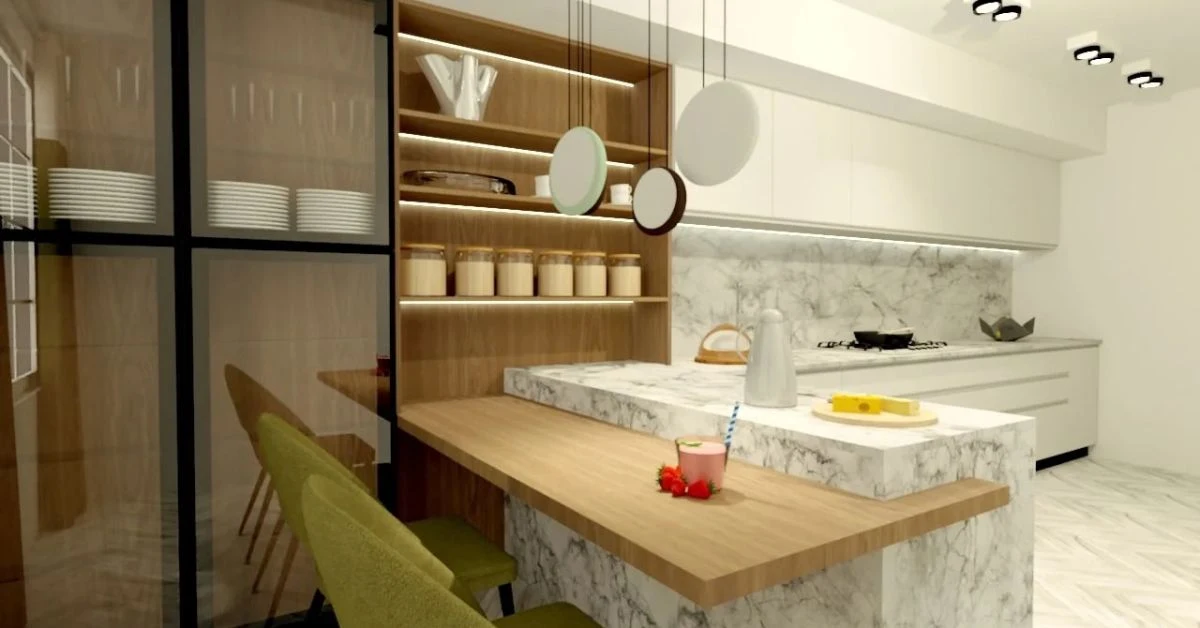
I work with a lot of busy LA families, and what I hear over and over is this: “Karina, I need my kitchen to do more.” I get it. Your island shouldn’t just sit there looking pretty; it should be working as hard as you are.
Here’s what I build into islands for families:
- Deep drawer banks on the cook’s side, no more hunting for the right lid
- Hidden appliance garages on the seating side so your blender isn’t living on the counter
- Built-in spice pull-outs right next to the prep zone, where you actually need them
- Charging drawers below the overhang, I cannot tell you how many clients message me saying this is their favorite thing in the whole kitchen
- Microwave drawers recessed into the island base, freeing up your counter completely
One thing I love doing for families with younger kids: dropping one section of the island counter to 34 inches instead of the standard 36. It creates a built-in homework nook or snack station at kid height, and it disappears completely into the design. Nobody knows it’s intentional until you tell them.
Luxury Kitchen Island Features Trending in Los Angeles
The definition of a luxury kitchen island has shifted. It used to mean expensive stone. Now it means a fully integrated experience, and honestly, that’s much more exciting.
Here’s what I’m putting into kitchens across Los Angeles right now:
- Built-in wine and beverage refrigerators are my most-requested feature, without question
- Induction cooktops are integrated into the island surface, so you’re cooking and connecting at the same time
- Statement pendant lighting in clusters of three, oversized sculptural fixtures in unlacquered brass or matte black that function as jewelry for the space
- Leathered or honed stone finishes instead of high polish, they’re more forgiving, more tactile, and they photograph beautifully
- Pop-up electrical outlets that retract flush when not in use, sleek, functional, essential
- Warming drawers, underrated until the moment you’re hosting Thanksgiving, and suddenly you can’t imagine life without one
I want to say something about lighting specifically, because I think it’s the most underestimated element in kitchen design. The pendants above your island aren’t just decorative. They define the island as a destination. They provide the task lighting you actually need for cooking. And they set the entire mood of your open-concept space from across the room. Get the pendants right, and everything else falls into place.
For clearance standards and layout guidelines, I always point my clients to the National Kitchen & Bath Association (NKBA), they publish detailed professional planning guidelines that are incredibly useful as a reference point.
Choosing the Right Size and Layout for Your Kitchen Island
This is where I see the most mistakes, so let me be direct with you.
Your island needs room to breathe. The NKBA recommends a minimum of 42 inches of clearance on all walkable sides. I push my clients toward 48 inches whenever the space allows, especially in open-concept homes where the kitchen flows into living and dining areas with real foot traffic.
Here’s how I generally size islands for my LA clients:
- Kitchens under 200 sq ft: a compact 36″ x 48″ island with seating on one side
- Kitchens 200–350 sq ft: a 48″ x 72″–84″ island with dedicated seating and prep zones
- Kitchens over 350 sq ft or full open-concept great rooms: consider going up to 48″ x 96″, or explore a double-island layout
Shape matters too. I default to rectangular for most kitchens, as it maximizes your prep surface and your seating. But for spaces with curved living room arrangements or a more organic layout, a curved island end can be stunning. It softens the geometry and makes the transition between the kitchen and living space feel much more intentional.
Materials and Finishes: That Elevate Open-Concept Kitchens
This is where I get to have some fun. Southern California homeowners have such a distinct sense of what they want: warm, organic, connected to the landscape, and the materials we’re working with right now reflect that beautifully.
For countertops, my current favorites are:
- Quartzite in warm whites and creams, all the beauty of marble, far more durable
- Dekton or sintered stone for islands near outdoor access, it handles UV and heat without complaint
- A section of white oak or walnut butcher block alongside the stone adds warmth, and that artisanal, custom feel
- Concrete for the more modern, industrial-leaning spaces I design in Silver Lake and Venice
For cabinetry and island bases, I’m seeing a strong preference for:
- Warm white painted cabinetry with brushed gold hardware. It’s timeless, and it works beautifully in California light
- Natural wood veneer panels on the island ends give the island a furniture quality that feels truly bespoke
- Two-tone approaches, where the island base contrasts the perimeter cabinets, navy, sage, and warm charcoal, are all having a moment right now
One thing I always remind my clients: in an open-concept space, your island is visible from your sofa. From your dining table. From your entryway. It’s not a kitchen element; it’s an interior design element. Treat it like one.
Common Kitchen Island Mistakes to Avoid
I want to save you from the things I wish more homeowners knew before they started. These are the mistakes I see most often:
- Undersizing the clearances. Forty-two inches is the minimum. If you can give yourself 48, do it.
- Getting the overhang depth wrong for seating. You need at least 12 inches for a stool to fit; I recommend 15–18 inches for genuine comfort.
- Skipping the prep sink. If your island is longer than 60 inches, a second sink is almost always worth every penny.
- Relying only on recessed lighting. Pendants above your island are not optional; they’re essential for both function and atmosphere.
- Forgetting what the island looks like from the living room. I always ask my clients to stand on their sofa and look toward the kitchen. Design from that vantage point, too.
- Not planning for outlets during rough-in. Adding power after the fact is expensive and disruptive. Plan it now.
- Mismatching the island style to the rest of the open plan. Your kitchen and living space read as one room. They need to feel like they belong together.
Balancing these technical elements with your personal style is exactly how I support homeowners through our custom design services in Los Angeles, guiding the project from the initial sketch to the final installation.
Frequently Asked Questions
How big should a kitchen island be for an open-concept home?
Start at a minimum of 48″ $\times$ 36″ (up to 96″ for large rooms), ensuring 42–48 inches of clearance on all sides.
How many stools can I fit at a kitchen island?
Plan for 24 inches of width per person, meaning three stools fit a 72″ island, and four stools fit an 84″ island.
What is the best layout for an open-concept kitchen?
A single rectangular island placed perpendicular to your main workspace maximizes flow, sightlines, and seating.
How much does a custom kitchen island cost in Los Angeles?
A quality custom island runs $8,000–$15,000, while high-end versions with built-in appliances and luxury stone cost $25,000–$50,000+.
What kitchen island features are trending in Los Angeles right now?
Waterfall quartzite counters, hidden pop-up outlets, beverage fridges, unlacquered brass pendants, and durable indoor-outdoor Dekton surfaces.
Let’s Design Your Kitchen Together
If there’s one thing I want you to take away from everything I’ve shared today, it’s this: your kitchen island should feel like it was made for your life. Not a showroom. Not a magazine. Your life, the way you cook, the way you gather, the way you live in your home.
At Karamia Designs, I work with homeowners across Los Angeles, Beverly Hills, Santa Monica, Pasadena, Manhattan Beach, and Culver City to design kitchens that are genuinely exceptional spaces that work beautifully and feel deeply personal.
I’d love to hear about your project. Whether you have a clear vision or you’re starting from scratch with nothing but a feeling, that’s exactly where I come in.
Book your complimentary consultation with Karamia Designs, and let’s start talking about your kitchen.