
Restaurant Interior Design Trends in Los Angeles (2026)
Los Angeles diners aren’t just eating out, they’re choosing between hundreds of restaurants competing for the same table, the same review, and the same repeat visit. In a market this saturated, interior design has quietly become one of the biggest drivers of whether a restaurant survives its first year or turns into a neighborhood staple.
At Karamia Designs, we work with restaurant owners across LA who are opening new concepts or renovating existing spaces, and the same question keeps coming up: what actually works right now? Below are the interior design trends shaping Los Angeles restaurants in 2026, and why each one directly affects table turns, reviews, and repeat business, not just aesthetics.
1. Layout Built Around Table Turns, Not Just Looks
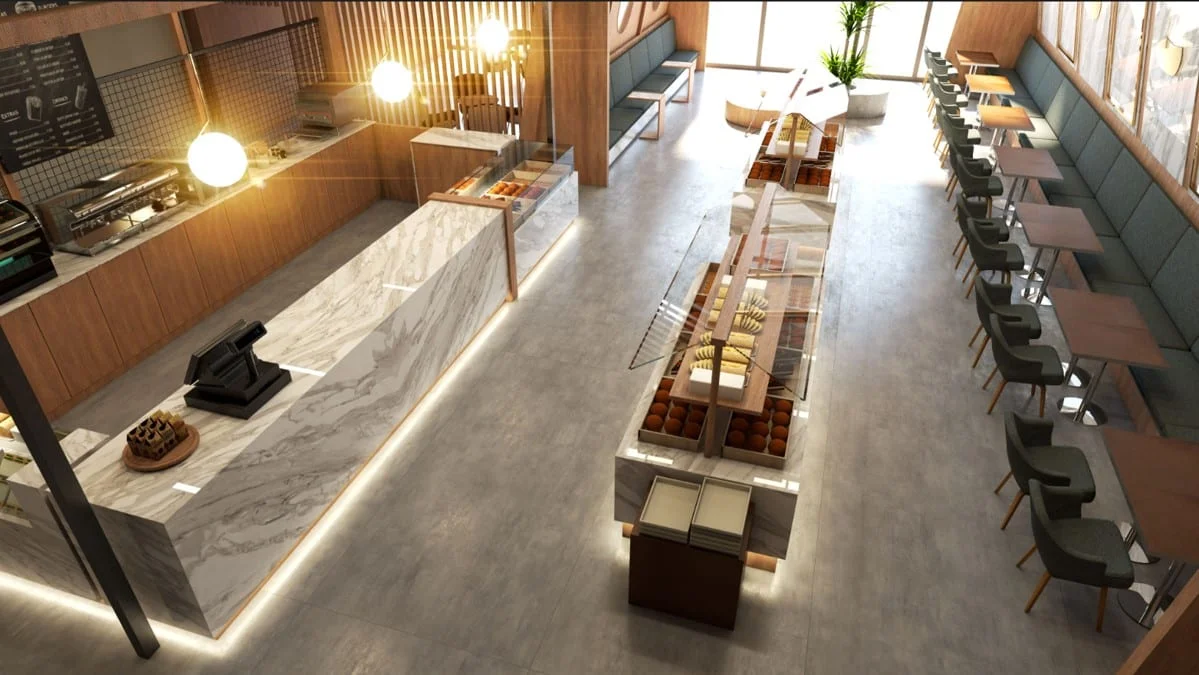
A beautiful dining room that slows your servers down is a beautiful dining room that loses money. In 2026, the strongest restaurant layouts treat flow as a revenue decision, not an afterthought. That means wide, unobstructed paths for staff carrying trays, no bottlenecks near host stands or bar entries, and clear zoning, high-energy tables near the entrance and bar, quieter seating deeper into the room.
For LA restaurants specifically, this matters more than in most cities because of how much walk-in and bar traffic competes with reservations. A layout that separates these flows without making the space feel chopped up is one of the highest-ROI changes an owner can make during a renovation.
2. Warm Minimalism Over “Instagram Wall” Design
The neon-sign-and-slogan-wall era is fading. What’s replacing it is often called “quiet luxury” in design circles, materials that age well (solid wood, natural stone, unlacquered brass) and spaces that don’t need a branded backdrop to feel expensive. The design itself becomes the identity, rather than a photo prop bolted onto the wall.
This shift is especially relevant in LA, where diners are design-literate and quick to notice when a space feels like a template. A restaurant that leans on real materials and a considered palette tends to earn organic social content instead of manufacturing it.
3. Layered, Adaptive Lighting
Lighting is doing more work than ever in restaurant design. Instead of one flat lighting scheme, LA restaurants are moving toward layered systems that shift subtly across the day, brighter and warmer for lunch service, dimmer and more directional for dinner. The goal is atmosphere that feels intentional without guests consciously noticing the mechanics behind it.
Good lighting design also solves a very LA-specific problem: restaurants with large windows or patio-adjacent dining rooms need lighting that holds up against strong daylight without washing out the interior mood.
4. Acoustic Design as a Retention Tool
Noise complaints are one of the most common reasons diners don’t return to a restaurant, even when they loved the food. Acoustic ceiling panels, upholstered banquettes, curved surfaces, and soft materials are being built into layouts from day one rather than added as a patch later. Arched or curved ceiling elements are also gaining traction because they diffuse sound naturally while adding a distinct visual signature to the room.
If your restaurant is getting great reviews for food but mixed reviews mentioning noise, this is usually a design problem, not a service problem, and it’s fixable.
5. Biophilic Materials and Natural Textures
Wood, linen, terracotta, rattan, and greenery continue to dominate 2026 restaurant interiors, replacing the harder, more industrial palettes of a few years ago. These materials read as calm and grounded, which matters in a city where dining out is often framed as an escape from a fast-paced day.
Sustainability is part of this too, sourcing FSC-certified wood or reclaimed materials gives owners a genuine story to tell, not just a design choice, and increasingly matters to LA diners who actively look for it.
6. Modular, Flexible Seating
Fixed banquettes for six and rigid four-tops are giving way to modular furniture that can reconfigure for a couple, a group of eight, or a private event without a full reset. For LA restaurants juggling everything from date-night covers to large celebration bookings, flexibility in the floor plan directly protects revenue on both slow nights and peak weekends.
7. Local Identity Over Generic Theming
Diners can spot a generic “Mediterranean restaurant” or “speakeasy” concept from across the room, and in 2026 that’s becoming a liability rather than a safe bet. The restaurants generating repeat visits and press coverage are the ones rooted in something specific, a founder’s story, a neighborhood’s history, a family recipe, translated into materials and layout rather than announced on a menu insert.
In a city as neighborhood-driven as Los Angeles, this local-identity approach also plays directly into how restaurants show up in local search and Google Business Profile categories, since specificity in design often mirrors specificity in how a restaurant describes itself online.
8. Outdoor and Indoor-Outdoor Dining as a Permanent Feature
What started as a pandemic-era workaround has become a permanent design expectation, and Los Angeles is arguably the best market in the country to lean into it. Retractable walls, heated patios, and outdoor bars are no longer bonus features, they’re being designed as core dining space from the start, with the same attention to lighting, acoustics, and materials as the interior.
9. Technology That Stays in the Background
Smart climate control, IoT-connected kitchens, and integrated ordering systems are increasingly standard, but the best 2026 restaurant interiors don’t make guests interact with the technology directly. QR-only menus and over-automated service are being scaled back in favor of tech that supports the staff and atmosphere invisibly. For LA restaurants competing on hospitality, this balance, efficient in the back of house, warm and human in the front of house, is becoming a real differentiator.
What This Means for LA Restaurant Owners
Every trend above ties back to the same three business outcomes: faster, smoother table turns; better reviews (fewer noise and comfort complaints); and a space distinctive enough to earn repeat visits and organic word of mouth. According to the National Restaurant Association’s ongoing industry research, operational efficiency and guest experience remain the top factors restaurants are optimizing for, and design is one of the few investments that improves both at once.
If you’re planning a new build-out or renovation in Los Angeles, the trends above are only useful if they’re adapted to your specific space, neighborhood, and concept, a generic “2026 restaurant” doesn’t perform the same way a space built around your actual brand does.
Ready to apply these trends to your space? Karamia Designs’ commercial interior design services in Los Angeles cover everything from layout planning and lighting design to material selection and permitting, built specifically around restaurants operating in LA’s market and code environment. Get in touch to start a project scope.
Frequently Asked Questions
What is the biggest restaurant interior design trend in Los Angeles for 2026?
Warm minimalism combined with flexible, revenue-driven layouts is the dominant direction, natural materials, layered lighting, and acoustic control replacing the louder, more novelty-driven designs of previous years.
How much does restaurant interior design cost in Los Angeles?
Costs vary widely based on square footage, scope (full build-out vs. refresh), and material selection. Working with a local commercial designer early helps avoid costly permitting and layout mistakes specific to LA’s building codes.
Does interior design actually affect restaurant reviews and repeat business?
Yes. Noise levels, seating comfort, and lighting are consistently cited in guest reviews, and layout directly affects table turn speed and staff efficiency, both of which show up in revenue.
Should outdoor dining be part of a Los Angeles restaurant’s design plan?
In most cases, yes. LA’s climate makes indoor-outdoor and patio dining a near-permanent design expectation rather than a seasonal add-on.