

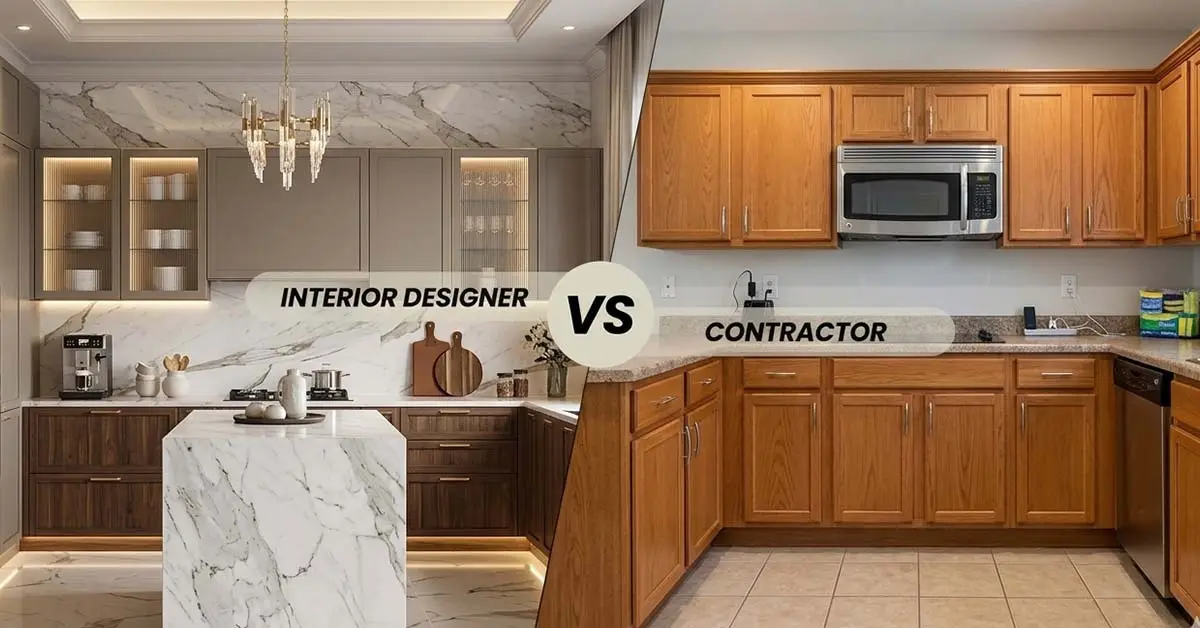
Interior Designer vs Contractor: Who Do You Need?
You’ve finally decided to renovate your home. Maybe it’s a kitchen that hasn’t been updated since 2003, or a living room that just doesn’t flow right. You’re excited, you have a budget in mind, and you’re ready to get started.
Then comes the first big question: Do I call an interior designer or a contractor?
It sounds simple, but getting this wrong can cost you thousands of dollars, weeks of delays, and a result that looks nothing like what you imagined. A lot of homeowners either skip the designer entirely and go straight to a contractor, or they hire a designer and then realise no one’s actually managing the build.
By the end, you’ll know exactly who to hire, when to hire them, and why the two roles are not interchangeable. You’ll also see how these decisions play out in real project examples.
This is where things often get confusing, especially for first-time homeowners.
Interior Designer vs Contractor: What’s the Difference?
|
Category |
Interior Designer | Contractor |
|
Main Role |
Plans and designs the space | Builds and executes the work |
|
What they handle |
Layout, aesthetics, materials, flow | Construction, permits, trade coordination |
| Decision-making | Guides design choices |
Executes approved plans |
| When you need them | Before and during the design phase |
During and after the design is finalized |
| Licensing | Varies by state (NCIDQ certified in many) |
Required for construction, electrical, and plumbing |
If you’re changing how a space looks and functions, you likely need a designer. If you’re changing how it’s built, you need a contractor. For most real renovations? You need both.
What Does an Interior Designer Actually Do?
An interior designer isn’t just someone who picks paint colors and throws pillows. That’s a common misconception, and an expensive one.
A qualified interior designer:
- Analyzes your space: traffic flow, natural light, proportions, ceiling height
- Creates a functional plan: where walls go, how rooms connect, what gets built-in vs. freestanding
- Selects materials and finishes: flooring, tile, cabinetry, countertops, fixtures
- Coordinates the aesthetic: so everything feels cohesive instead of like a Pinterest board exploded
- Manages specs and sourcing: orders furniture, oversees lead times, tracks delivery
- Communicates with your contractor: translates your vision into buildable plans
In short, a designer figures out what gets done and how it should look before a single nail is hammered.
What Does a Contractor Do?
A general contractor is the person (or company) who actually builds things. They’re licensed to perform or oversee construction work, and they’re legally responsible for the safety of that work.
A contractor:
- Pulls permits: required for structural, electrical, and plumbing work in most states
- Manages subcontractors: electricians, plumbers, tile setters, drywall crews
- Handles the build schedule: sequencing work so it happens in the right order
- Ensures code compliance: your renovation has to meet local building codes
- Manages the job site: materials, waste, safety, inspections
A contractor brings your approved plans to life. They’re not there to help you decide what you want; they’re there to build what you’ve decided.
Key Differences Between an Interior Designer and a Contractor
1. Design vs. Execution
An interior designer works in the planning and creative phase. A contractor works in the building and execution phase. One comes before the other, and mixing up the order causes real problems.
2. Decision-Making
Your designer helps you make decisions about what the space will be. Your contractor makes decisions about how to build it safely and efficiently. Both roles involve expertise, but they’re operating in completely different domains.
3. Project Timeline Involvement
Designers are typically most active at the start of a project, and continue in a coordination role as it moves through construction. Contractors are most active once plans are finalized and permits are pulled.
4. Licensing and Training
Interior designers may hold certifications like the NCIDQ (National Council for Interior Design Qualification) and, depending on your state, may be required to be licensed. Contractors must be licensed by their state for construction work; unlicensed contracting is illegal in most of the US.
5. Scope of Work
A designer’s scope is creative and spatial. A contractor’s scope is physical and technical. Neither can fully replace the other.
When You Need an Interior Designer
Hire an interior designer if any of these sound familiar:
- You’re not sure how to use the space: Maybe the layout technically works, but it never feels right. A designer can identify why and fix it.
- You want the renovation to feel cohesive: Without someone managing the full aesthetic, you often end up with finishes that clash, proportions that feel off, or a kitchen that looks like it came from three different decades.
- You’re making big purchases: Cabinets, countertops, and flooring are expensive and permanent. Having a professional guide your selections reduces costly mistakes.
- You’re combining function and style: A bathroom remodel isn’t just about what looks good; it’s about storage, accessibility, lighting, and flow. A designer thinks through all of it.
- You want to maximize square footage: Especially in smaller homes, strategic design makes a dramatic difference in how spacious a space feels.
When You Need a Contractor
You need a licensed contractor if your project involves:
- Structural changes: removing walls, adding a room, changing the roofline
- Electrical work: adding outlets, upgrading your panel, and recessed lighting
- Plumbing: moving a sink, adding a bathroom, relocating fixtures
- HVAC: new ductwork, adding vents, installing a unit
- Anything requiring permits, which in most US cities and counties is almost every meaningful renovation
Even if you’ve designed the project down to the last detail, you’ll need a licensed contractor to make it legally happen.
When You Need Both and Why It Matters
Here’s the truth that most homeowners skip: for any meaningful home renovation, you almost always need both.
The interior designer plans the space. The contractor builds it. When these two professionals work together from the beginning, the result is almost always better and significantly less stressful.
Here’s what happens when they don’t coordinate:
- The contractor builds something that looks fine structurally but doesn’t match the designer’s intent
- Expensive materials arrive that don’t fit the space as built
- Design decisions get made on the fly by whoever’s available, usually the contractor, who may have no design background
- Change orders pile up because the build plan didn’t account for design details
Firms like Karamia Designs approach projects with this coordination built in from day one, ensuring that the design vision and the construction reality are aligned before anything is torn out or ordered. That kind of integrated process tends to save both time and money over the course of a project.
Common Mistakes Homeowners Make
Hiring the Contractor First
This is the most common mistake. You get excited, you want to move fast, you call a contractor. They start demoing. Now you’re making design decisions under pressure, mid-construction, with material lead times and a crew waiting on your call.
Design should come first. Always.
Skipping the Design Phase to Save Money
The design phase feels like an added cost when you’re staring at a budget. But unplanned renovations routinely cost more, because of change orders, do-overs, and materials that don’t work together. Design clarity upfront prevents expensive chaos later.
Treating the Designer and Contractor as Separate Silos
The best renovations happen when the designer and contractor are in communication throughout the project. If you’ve hired both but they’ve never met, that’s a problem waiting to happen.
Misallocating Budget
Spending too much on labor before locking in a design often means you run out of budget for the finishes that make the space feel special, the details that you actually see every day.
A Note on Cost
Designers typically charge in one of three ways: flat fee, hourly rate, or a percentage of the overall project budget. Contractors bill by project, square footage, or time-and-materials.
The key mindset shift: don’t ask “what does a designer cost?” ask “what does skipping a designer cost?” Change orders, rushed decisions, and redone work can easily exceed design fees several times over.
Think of both as investments with different returns. The contractor builds your home. The designer makes sure it’s worth living in.
Real-Life Example: A Kitchen Remodel
Let’s walk through how this plays out on a typical kitchen renovation.
Phase 1: Design (Interior Designer)
The designer evaluates the current layout. They realize that moving the island two feet would dramatically improve workflow and allow natural light to reach the sink. They specify cabinetry, countertop material, tile backsplash, lighting fixtures, hardware, and appliance placement. They produce detailed drawings.
Phase 2: Pre-Construction Planning (Designer + Contractor)
The contractor reviews the design drawings and flags that the electrical panel will need an upgrade to support the new appliances. The designer adjusts the lighting plan to work with the new circuit. This conversation, happening before the demo, saves what could have been a $3,000 mid-project surprise.
Phase 3: Construction (Contractor)
The contractor pulls permits, coordinates the demo crew, electrician, plumber, and tile setter. Work is sequenced properly. Inspections happen on schedule.
Phase 4: Finish and Styling (Designer)
The designer is on-site as cabinets are installed to ensure everything matches the spec. They source and place final styling elements. The client walks into a kitchen that looks exactly like, or better than, what they imagined.
Without the designer, that kitchen might have been competently built but never quite right. Without the contractor, none of it gets built at all.
The Decision Is Simpler Than You Think
Here’s how to decide:
- Cosmetic updates only (new paint, swapping fixtures, new furniture), the designer alone is often enough
- Construction or trades work only (fixing what’s broken, structural repair), Contractor alone
- Any meaningful renovation starts with a designer, bring in a contractor once plans are solid
If you’re still not sure, most designers will offer a consultation. Use it. An hour with a qualified designer at the start of a project is one of the most valuable hours you’ll spend.
Interior Designer or Contractor: FAQs Homeowners Ask
Do I need an interior designer or a contractor for a home renovation?
Most renovations need both professionals in the right order: start with an interior designer to finalize the plan, then hire a contractor to build it. For simple repairs, a contractor may be enough, but for layout or design changes, always begin with a designer.
Can an interior designer also act as a general contractor?
An interior designer can’t legally act as a contractor unless they also hold a contractor’s license. Most structural, electrical, and plumbing work requires a licensed general contractor. Some firms offer both services together, but always verify proper licensing before hiring.
What’s the difference between an interior designer and an interior decorator?
An interior decorator focuses on styling, like furniture, colors, and accessories, without changing the structure or layout. An interior designer works on space planning and can handle layout or renovation changes. For renovations, you need a designer; decorators are best for simple furnishing or cosmetic updates.
My contractor gave me a quote before I had a design. Is that a problem?
Without a finalized design, any contractor quote is just an estimate. Once design details are finalized, changes usually lead to costly change orders. Always complete the design first, then get an accurate, itemized contractor quote.
Final Thoughts
The interior designer vs. contractor debate isn’t really a debate; they do fundamentally different things, and most renovations need both. The confusion comes from not understanding where one role ends and the other begins.
Hire your designer first. Let them think before the building starts. Then bring in a contractor who can execute a clear, well-planned vision.
That order of operations is the difference between a renovation that stresses you out and one that actually delivers what you paid for.