

How to Choose the Right Shoe Rack for a Closet
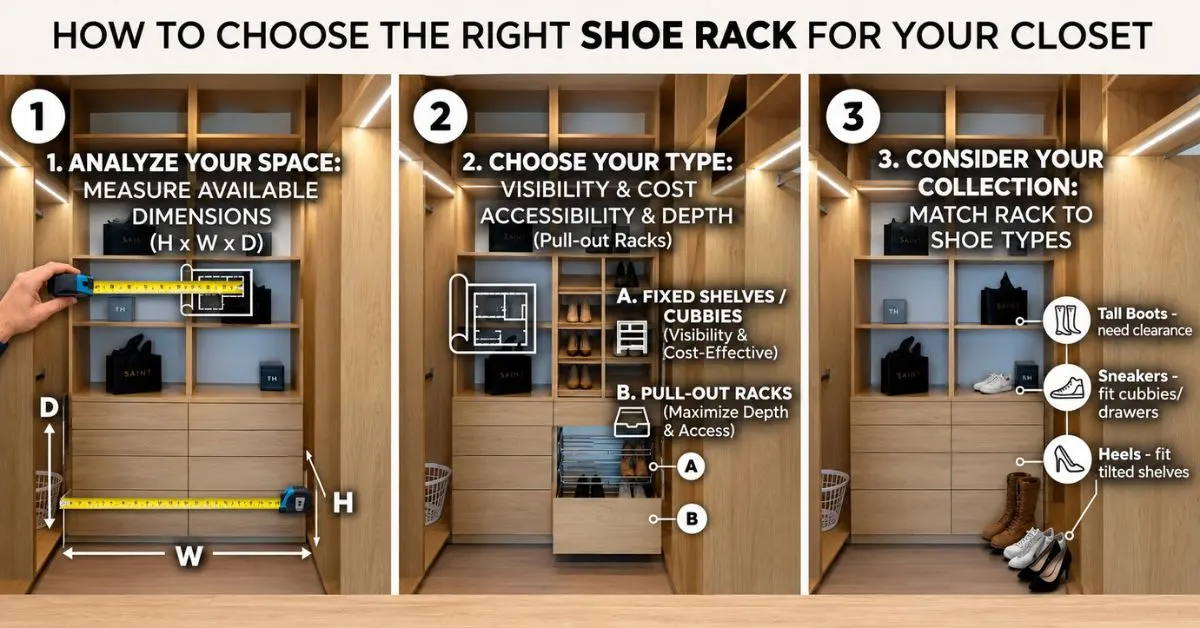
Choosing the right shoe rack for a closet starts with three things: the space available, the types of shoes you own, and how easily you want to access them.
A shallow rack may work well for flats and everyday sneakers, while heels, ankle boots, and tall boots may need different shelf spacing or a dedicated storage section. The best option is not necessarily the one that holds the most pairs; it is the one that fits your closet without blocking doors, crowding clothing, or making shoes difficult to reach.
Before choosing a shoe rack, measure the usable width, depth, and height of the intended space. Then compare adjustable shelves, pull-out racks, freestanding units, angled shelves, and integrated closet storage against your footwear collection and daily routine.
How to Choose a Shoe Rack for a Closet: The Quick Checklist
Use this checklist before comparing rack styles:
- Measure the available space: Record the usable width, depth, and height where the rack will sit.
- Measure your largest shoes: Check the length, width, and height of the footwear that needs to fit.
- Decide what needs to be stored: Everyday sneakers, formal heels, sandals, ankle boots, and tall boots may need different arrangements.
- Choose your access style: Open shelves provide visibility; pull-out storage can make deeper spaces easier to reach; closed storage conceals footwear.
- Check the surrounding layout: Make sure the rack does not interfere with closet doors, hanging clothes, drawers, or the walking area.
- Consider the overall design: The rack’s material, finish, proportions, and visual weight should work with the rest of the closet. These considerations are also part of closet interior design, where storage, layout, and finishes are planned to work together.
These checks help narrow the options before you commit to a particular rack or storage configuration.
1. Measure Your Closet Before Choosing a Shoe Rack
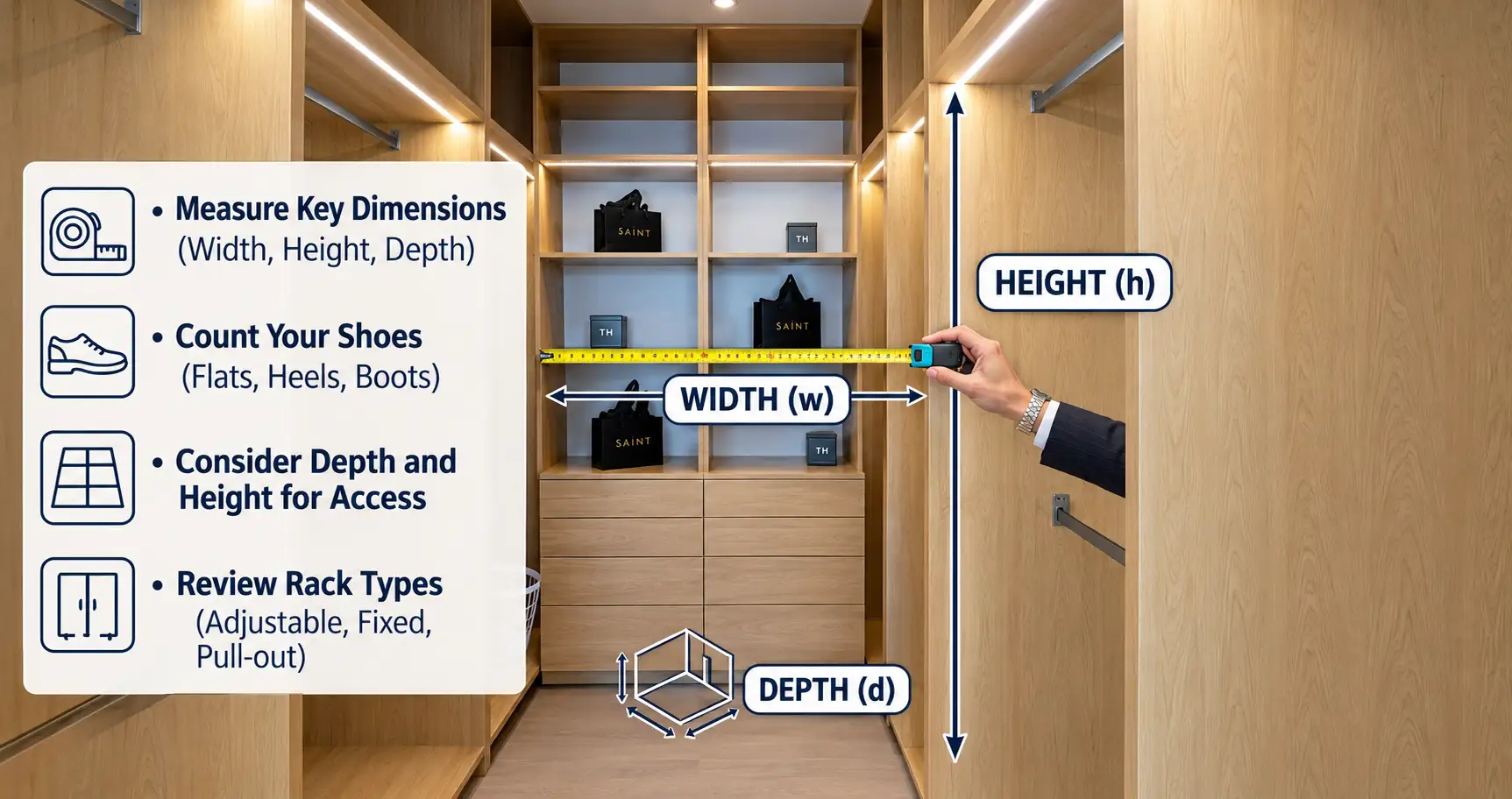
The first step is to measure the space where the rack will go, not to choose a rack based on its appearance or advertised pair capacity. A unit can fit the overall closet dimensions but still interfere with hanging garments, doors, or access to other storage. These measurements also help establish how closet storage fits into the wider considerations of residential interior design, including space planning, functionality, and the relationship between different areas of the home.
Measure the usable width
Measure the clear horizontal space available for the rack. Account for nearby drawers, side panels, door trim, and any other elements that reduce the usable width.
If the rack will sit between two closet sections, measure the narrowest point. Do not assume that a measurement taken at the top will match the space available at floor level.
Measure the usable depth
Measure from the back wall to the point where the rack can end without interfering with doors, hanging clothes, or movement.
Depth deserves particular attention in reach-in closets. A rack that projects too far forward can compete with the space needed for clothing or make items at the back harder to access. For a walk-in closet, check whether the rack leaves enough room to move comfortably through the space.
Compare the rack’s listed depth with the dimensions of your longest shoes. If footwear extends beyond the shelf, check whether that overhang will catch on clothing, obstruct a door, or create a problem in the walkway.
Measure the available height
Measure the clear height from the floor or shelf surface to the lowest obstruction above the intended rack. This could be a fixed shelf, hanging rod, drawer, or the underside of another storage unit.
The rack itself must fit within this space, but the shoes need clearance too. Leave enough room to lift a pair off the shelf without scraping the shelf above it.
Measure the shoes, not just the closet
Use your largest or bulkiest everyday pair as a practical reference. Measure:
- Length: From the heel to the tip of the toe.
- Width: Across the widest part of the shoe.
- Height: From the sole to the highest point, including the heel or boot shaft when relevant.
For a pair of tall boots, measure the shaft height as well. A shelf that accommodates sneakers may not have enough vertical clearance for boots.
There is no single shoe-rack dimension that works for every collection. Shoe size, toe shape, heel height, shelf angle, and the way pairs are arranged all affect fit. Use the measurements of your own footwear to assess a rack rather than relying only on a general size guide.
A practical fit test: Mark the proposed rack’s width and depth on the floor with removable tape. Check the closet doors, drawers, and hanging garments in their normal positions. This simple layout check can reveal conflicts before you select a rack.
2. Compare the Main Types of Shoe Racks for Closets
Different rack styles solve different storage problems. Some prioritize flexibility, others prioritize visibility, accessibility, or a streamlined appearance.
Adjustable shoe shelves
Adjustable shelves allow the vertical space between levels to change as your footwear needs change. They are useful when a collection includes both low-profile shoes and taller styles.
- Best suited to: Mixed footwear collections, changing storage needs, and closets that need flexible shelf spacing.
- What to consider: Check how the shelf supports are adjusted and whether the available positions can accommodate your most high-heeled shoes. A highly adjustable system is useful only when the shelf positions match the collection.
Pull-out shoe racks or trays
Pull-out storage brings footwear forward rather than requiring you to reach into a deep space. It can be helpful when shoes are stored inside a deeper closet section or behind a cabinet-style front.
- Best suited to: Deeper storage zones where shoes at the back would otherwise be difficult to see or retrieve.
- What to consider: Check the full depth of the unit, its usable width, the clearance required for it to extend, and the space needed to reach the shoes. A pull-out feature does not automatically increase capacity; its main benefit is access.
Freestanding tiered racks
A freestanding rack is a separate unit with multiple levels. It can be a practical option when you want a flexible arrangement rather than storage planned as part of the closet layout.
- Best suited to: Everyday footwear, flexible storage arrangements, and spaces where the rack may need to be moved or changed later.
- What to consider: Confirm the rack’s footprint, stability, shelf depth, and the spacing between tiers. Check whether its materials and finish suit the surrounding closet. Also consider whether an open rack will leave footwear visually exposed.
Angled shoe shelves
Angled shelves tilt shoes so more of their upper surface is visible. This can make a display-oriented closet feel more curated and can help you identify pairs at a glance.
- Best suited to: Display-focused closets where visibility is a priority.
- What to consider: Compare the usable shelf area and pair arrangement with a flat shelf. Depending on the design, angled shelves may accommodate fewer pairs across the same area. Check the front edge or retaining detail so footwear stays securely in place.
Built-in or integrated shoe storage
Integrated storage is planned alongside the closet’s hanging areas, drawers, shelves, and other storage zones. It may use open shelves, individual compartments, drawers, or display sections.
- Best suited to: Closets where footwear storage needs to coordinate with the overall layout, materials, and visual design.
- What to consider: Plan the storage around the actual footwear collection and available dimensions. Fixed compartments can look orderly, but a single repeated size may not work for flats, heels, sneakers, and tall boots equally well.
The choice of shelving, materials, and finishes can influence how shoe storage fits into the overall closet design. Examples of these elements can be seen in the closet design portfolio.
3. Shoe Rack Comparison: Which Type Fits Your Needs?
| Shoe rack type | Main advantage | Best fit for | Main consideration |
| Adjustable shelves | Flexible vertical spacing | Mixed shoe types | Confirm the adjustment range |
| Pull-out trays | Easier access to deeper storage | Deep closet sections | Check extension and access clearance |
| Freestanding rack | Flexible, separate unit | Everyday shoes and adaptable layouts | Check stability, footprint, and appearance |
| Angled shelves | Strong visibility and display | Display-oriented closets | May reduce usable capacity |
| Integrated storage | Coordinated with the full closet layout | Tailored closet interiors | Needs careful planning around real shoe dimensions |
Choose adjustable shelves when flexibility matters most, pull-out storage when access to depth is the problem, a freestanding rack when you need a separate and adaptable unit, angled shelves when display is the priority, and integrated storage when the entire closet layout needs to work as one cohesive design.
4. Choose Shelf Depth and Spacing for Your Shoes
A shoe rack can have enough overall width and still be impractical if the shelves are too shallow or the gaps between them are too low.
Flats, sandals, and low-profile shoes
These styles generally need less vertical clearance than high heels or boots. They can often share a shelf zone, provided the shelf depth accommodates the longest pair and the pairs are easy to remove.
Avoid making the spacing so tight that you have to pull out neighboring shoes to retrieve one pair.
Sneakers and athletic shoes
Sneakers may have thicker soles, wider uppers, or a bulkier shape than flats. Measure the pair that occupies the most space in your collection rather than assuming every sneaker will fit the same way.
If the shoes are wide, check how many pairs can sit side by side without being squeezed together.
Heels and dress shoes
Heels may need more vertical clearance than flats, especially when the heel or upper rises above the sole. Their shape can also affect how securely they sit on a shelf.
Check that the heel does not collide with the shelf above and that the shoe can be removed without catching on neighboring pairs. For narrow heels, examine the shelf surface and supports to ensure the footwear sits securely.
Ankle boots and tall boots
Boots need more than additional shelf depth: their height and shaft shape also matter. Ankle boots may fit in a general shoe zone if the vertical gap is sufficient. Taller boots may need a dedicated bay or a shelf arrangement that leaves a larger opening.
Measure the actual boot shaft before allocating space. If you want boots stored upright, account for the height they need in that position rather than folding or compressing them to fit a standard shelf.
Should every shelf have the same height?
Not necessarily. Repeating identical shelf spacing can create a neat appearance, but it may waste space when the collection contains different footwear types.
A more adaptable layout can use tighter spacing for low-profile shoes and taller openings for heels or boots. The aim is to balance useful capacity with easy access, not to make every shelf identical.
5. Choose a Shoe Rack for Your Closet Layout
The available floor area and the way you use the closet should influence the type of rack you choose.
For a small closet
Prioritize the usable footprint. A narrow or vertically arranged rack may be more practical than a wide unit, but height alone is not a solution if the upper shelves become difficult to reach.
Consider keeping frequently worn pairs in the easiest-to-access zone and placing occasional or seasonal footwear elsewhere. If hanging garments extend close to the floor, check that a rack will not push them forward or interfere with their movement.
For a reach-in closet
Reach-in closets often have limited depth and doors that affect access. Measure the space behind the door opening and the area occupied by hanging clothes before choosing a floor-standing rack.
A shallow unit may preserve more of the usable closet area, while a pull-out or integrated option may make sense where deeper storage already exists. The right choice depends on the actual dimensions, not on the label “reach-in.”
For a walk-in closet
A walk-in closet may offer more wall and floor space, but shoe storage still needs to work alongside hanging sections, drawers, and circulation.
A dedicated shoe wall, adjustable shelving, or integrated display area can work well when the collection justifies it. Keep everyday pairs accessible and avoid using the easiest-to-reach shelves for footwear that is rarely worn.
A well-planned walk-in closet layout considers how shoe storage fits alongside hanging sections, drawers, and circulation space. This article focuses specifically on selecting a rack that fits your footwear and available dimensions.
Storage placement also affects how easily shoes and other closet items can be seen and reached. The National Kitchen & Bath Association discusses these considerations in its article on closet storage and accessibility.
For a shared closet
When two people use the same closet, consider separate shoe zones or clearly defined sections. This can reduce crowding and make it easier to accommodate different shoe sizes and preferences.
Plan for each person’s actual footwear rather than dividing the shelf area equally by default. One person may need more space for boots, while the other may have more low-profile pairs.
6. How Many Shoes Should a Rack Hold?
A rack’s advertised capacity is only a starting point. The number of pairs it can hold in practice depends on shelf width, depth, spacing, shoe size, and arrangement.
Before choosing a capacity, count the pairs that will actually live in the closet. Separate everyday footwear from seasonal or occasional shoes, and decide whether boots and bulky sneakers will share the same rack.
Then compare the usable shelf dimensions with your shoes. A rack that accommodates many narrow pairs may hold fewer wide sneakers or larger shoes. Angled shelves, individual compartments, and unusual shoe shapes can also affect the count.
Avoid choosing a rack solely because its product listing promises a particular number of pairs. If possible, assess the dimensions of each shelf and the space required to retrieve footwear comfortably.
7. Make the Shoe Rack Work With the Closet Design
A shoe rack is a functional storage element, but its appearance can influence how cohesive the closet feels.
Coordinate materials and finishes
Consider the rack alongside the closet’s cabinetry, shelving, hardware, and overall palette. A finish that relates to nearby materials can help a separate rack feel intentional. For an integrated design, consistency in materials and proportions can create a more unified appearance.
Balance display with concealment
Open shelving makes footwear visible and easy to identify, but it also keeps every pair in view. Closed compartments can create a more visually restrained look, although they may make individual pairs less visible.
In a display-focused space, boutique-style closet design offers another perspective on coordinating visible storage, finishes, and the overall appearance.
Keep frequently used shoes accessible
Place everyday footwear where you can see and reach it without moving other items. Less frequently worn pairs can occupy higher or less convenient zones if they remain safely accessible.
This is a layout decision as much as an organization decision: storage should reflect how the closet is used, not only how it looks when everything is arranged.
Avoid designing around one shoe type
A closet planned only for sneakers may not work well when the collection includes heels and tall boots. A more considered layout accounts for different shoe heights, widths, and access needs from the beginning.
A closet design service can account for available dimensions, storage zones, accessibility, materials, and finishes as part of a tailored closet interior. The goal is to plan storage around the space and the person using it, rather than forcing every collection into the same configuration.
8. Common Mistakes to Avoid When Choosing a Closet Shoe Rack
- Choosing by appearance alone. A rack may look right but still be too deep, too wide, or difficult to access. Confirm the dimensions first.
- Ignoring door and drawer clearance. A rack that blocks a door or prevents a drawer from opening can make the whole closet less functional.
- Using the same spacing for every shoe. Flats, heels, sneakers, and boots do not always fit comfortably within identical shelf openings.
- Overestimating capacity. Advertised pair counts may not reflect your shoe sizes or the arrangement you prefer. Compare usable shelf space with the actual collection.
- Putting everyday shoes in hard-to-reach areas. Frequently used pairs should be easy to identify and retrieve.
- Forgetting about stability. Check that a freestanding unit is stable on the intended surface and appropriate for the footwear it will hold.
- Choosing fixed compartments before checking the collection. Uniform compartments may look orderly, but they can waste space or exclude bulkier footwear.
- Treating the rack as a separate decision from the closet. The rack should work with hanging clothes, drawers, lighting, finishes, and the available circulation space.
Frequently Asked Questions
What type of shoe rack is best for a closet?
The best shoe rack depends on your available space, footwear collection, and access needs. Adjustable shelves work well for mixed shoe types, pull-out racks improve access to deeper storage, freestanding racks offer flexibility, and integrated storage can complement the overall closet layout.
How do I measure for a shoe rack in a closet?
Measure the usable width, depth, and height of the intended space. Then measure your largest shoes and compare their dimensions with the rack’s shelf depth and vertical clearance. Check that the rack does not interfere with closet doors, drawers, or hanging clothes.
How deep should a shoe rack be?
The appropriate depth depends on the size of your shoes and the available closet space. Compare the shelf depth with the length of your longest pair, allowing for any overhang. Ensure the rack does not obstruct doors, clothing, or walkways.
What is the best shoe rack for a small closet?
A compact rack that fits the available width and depth is a practical starting point. Vertical storage can help maximize limited floor space, provided the upper shelves remain accessible, and the rack does not interfere with hanging clothes or closet doors.
How should I store boots on a shoe rack?
Choose shelves with enough depth and vertical clearance to accommodate your boots without forcing them into a cramped position. Ankle boots may fit on standard shoe shelves, while taller boots often need a dedicated storage section with additional height.
Choose a Shoe Rack That Fits Your Space and Routine
The right shoe rack for a closet fits the available dimensions, accommodates the footwear you own, and makes everyday access straightforward. Start by measuring the space, comparing rack types, and checking shelf depth, vertical clearance, stability, and door movement.
The best choice ultimately depends on your closet’s layout, the shoes you need to store, and your daily routine. These factors also help determine how storage can fit into the overall closet design. For questions about planning your closet space, you can contact Karamia Designs.